
What the Vesuvius Scrolls Are Saying Now
In June a burned Herculaneum scroll was read from end to end without being opened. It turned out to be Stoic ethics, and its last column names a nephew of Chrysippus. Here is what changed, and what still has to be proved.
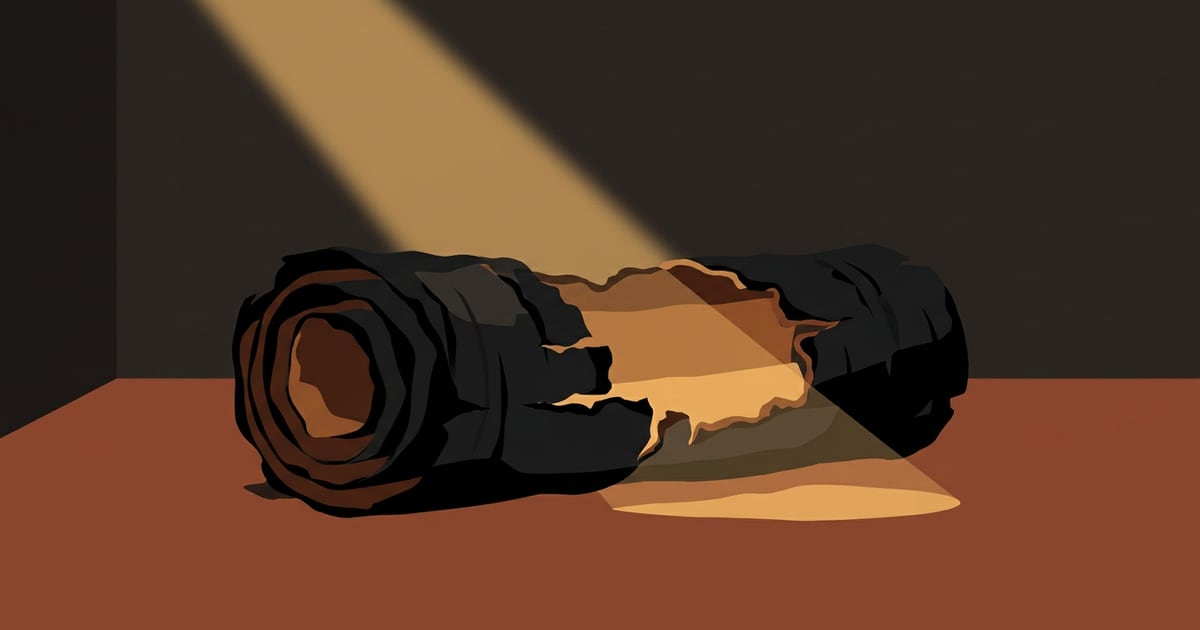
On June 25, in the National Library of Naples, the team behind the Vesuvius Challenge announced something no one had done before: a Herculaneum scroll had been read from beginning to end without anyone unrolling it.
The scroll is catalogued as PHerc. 1667, and it was nobody's idea of a promising candidate. Attempts to open it by hand had stripped away its outer layers. "This scroll was deemed completely unreadable when part of it was opened in the 1980s," says the papyrologist Federica Nicolardi. What survives is a compact core about 8 centimeters tall, the remnant of a roll that once stood 19 to 24 centimeters. Inside that core, X-ray scans found roughly 1.4 meters of papyrus wound around itself, carrying the lower parts of twenty-odd columns of Greek.
When we wrote about these scrolls in June, the headline was a title read from inside a sealed roll. Four months later the headline is a whole book, and it is not the kind of book the library is famous for.
A Stoic voice in an Epicurean library
The Villa of the Papyri is usually described as the library of Philodemus, an Epicurean philosopher of the first century BCE, and most of what has been read from it supports that picture. Epicureans and Stoics were rivals. The passage that won the Challenge's 2023 Grand Prize even takes a jab at the Stoics for having nothing to say about pleasure.
PHerc. 1667 comes from the other side of that argument. According to the team, it is a treatise on ethics, probably concerned with whether human beings can be morally perfected, and the evidence points to a Stoic work of the second century BCE, possibly the late third. Its last preserved column names Aristocreon, the nephew and pupil of Chrysippus, the thinker who did more than anyone to systematize early Stoicism.
That has raised the obvious hope that the author is Chrysippus himself. Hold it loosely. Ancient tradition credits him with more than seven hundred books, and no complete treatise of his survives, which is exactly why a first-hand Stoic text would matter. But a name in the final column is not a signature. The University of Kentucky's release lists the author as unknown, with Chrysippus as a possible candidate. The library was not purely Epicurean before June, either: a damaged roll of Chrysippus' Logical Questions, PHerc. 307, was identified there long ago. What is new is an ethical treatise from the early Stoa, read whole.
How you read a book that cannot be opened
The pipeline sounds simpler than it is. The scroll was scanned with phase-contrast X-ray microtomography on the BM18 beamline of the European Synchrotron in Grenoble. Software then followed the papyrus sheet through the scan in three dimensions, which is hard because the layers are crushed, fused, and in places touching. The traced surface was flattened into a virtual page. Machine-learning models looked for carbon ink, which barely differs from carbonized papyrus in an X-ray. Papyrologists then checked and transcribed what the models found.
Two other results from the same announcement show how quickly the tools are improving. In PHerc. Paris 4, the scroll behind the 2023 prize, a better scan now makes the ink directly visible in the three-dimensional data, and it matches the 2023 reading one to one. In PHerc. 139, the team recovered the closing title: Philodemus, On Gods, Book 8. Only Book 1 of that work was previously known.
The scans, the code, and the transcriptions are public. For a field in which checking someone's reading has always meant a trip to Naples, that may matter as much as the reading itself.
Two Stoic words and a numeral
Here is where the Greek stops being decoration.
According to the University of Kentucky, PHerc. 1667 discusses ὁρμή (hormḗ) and φρόνησις (phrónēsis). Both are working parts of Stoic ethics, and both are easy to flatten in English.
Hormḗ literally means a rush or onset, something set in motion; English hormone was built from the same root. The usual translation is "impulse." But for a Stoic, an impulse in an adult human is not a blind urge. It follows the mind's assent to an impression, which is why Stoics could hold people responsible for their impulses. Read "impulse" with its everyday English sense and the argument quietly changes.
Phrónēsis is practical wisdom, the first of the cardinal virtues in the Stoic list. It reached English through Latin as "prudence," a word that now suggests caution with money. A treatise about whether humans can be perfected that keeps returning to phrónēsis is asking whether a person can learn to judge rightly every time. "Prudence" makes it sound like a book about savings accounts.
Then the numeral. Greek wrote numbers with letters, marked by a stroke above them. The end-title of PHerc. 139 closes with an overlined Η (ēta), and in that system eta means eight. A single letter carries the book number, which is why one damaged letter can carry an argument. When the title of PHerc. 172 was read in 2025, its book number was "plausibly read as an alpha," Book 1, though delta, Book 4, could not be completely ruled out. In a capital hand both are triangles. If it is Book 1, it collides with the long-held view that the first book of Philodemus' On Vices was On Flattery.
A translation prints "Book 1" and moves on. The Greek shows you the stroke the question hangs on.
What could change the answer
Much of this is new. The full transcription of PHerc. 1667 was posted as a preprint in June, and editions, corrections, and arguments will follow. The readings are fragmentary where the surface is lost, and the authorship question may never be settled.
The next readings may arrive faster. The Challenge has put up a $1 million Grand Prize, with a deadline of June 25, 2027, for fully unrolling and making readable another complete scroll from an eligible set using no more than eight hours of human input. The limit is the point: the project wants methods that can work through a library, not heroic one-off efforts.
A September study in PLOS ONE suggests where to look first. Douglas Seiler and colleagues wrote on new papyrus with lampblack ink mixed with lead, sealed the roll in a steel container with very little oxygen, charred it in a furnace, and scanned it. The lead-bearing letters lit up, and ink with as little as 25 micrograms of lead per square centimeter was detectable both by CT and by handheld X-ray fluorescence. The team proposes screening the roughly 1,800 surviving scrolls and fragments with cheap fluorescence readings before committing costly scans to them.
More than 600 Herculaneum scrolls remain unopened, and parts of the villa have never been excavated.
"This is not just a technical recovery," Nicolardi says. "It's the return of a philosophical voice." The voice is speaking Greek, and its technical words were chosen with care. That is the pleasure PRAVIEL is built around: getting far enough into the language that a word like hormḗ stops being a gloss and becomes a choice you can watch a translator make.
Sources
- Vesuvius Challenge, "An entire Herculaneum scroll has been read for the first time"
- Angelotti, Parsons, Nicolardi, Nader, Johnson et al., "Complete virtual unwrapping and reading of a rolled Herculaneum papyrus" (arXiv preprint, June 2026)
- University of Kentucky, "The day the Herculaneum scrolls began speaking again"
- Vesuvius Challenge, 2023 Grand Prize announcement
- Fine Books Magazine, on the title of PHerc. 172
- Vesuvius Challenge, "A New $1M Grand Prize for 2027"
- Seiler et al., "A model carbonized papyrus scroll opens a novel path to identifying readable scrolls of the Herculaneum Library," PLOS ONE (2026)
- Internet Encyclopedia of Philosophy, "Chrysippus"
- Stanford Encyclopedia of Philosophy, "Stoicism"
- Oxford, facsimile record of PHerc. 307, Chrysippus, Logical Questions
Ready to learn an ancient language?
Learn a few minutes a day, from the first letters to real texts, with every line spoken in the language's own tradition. Start free with Latin or Greek, or with Egyptian, Hebrew, and more.
Conversation
Comments
Leave a note, correction, or question. Comments are moderated and email addresses are not shown publicly.
Loading comments...