
The Cyclops Joke Nolan Couldn't Translate
Christopher Nolan left Homer's most famous joke out of The Odyssey. "Puns in translation are tough," he said. In Greek the trick works twice, and the second half has never survived translation.
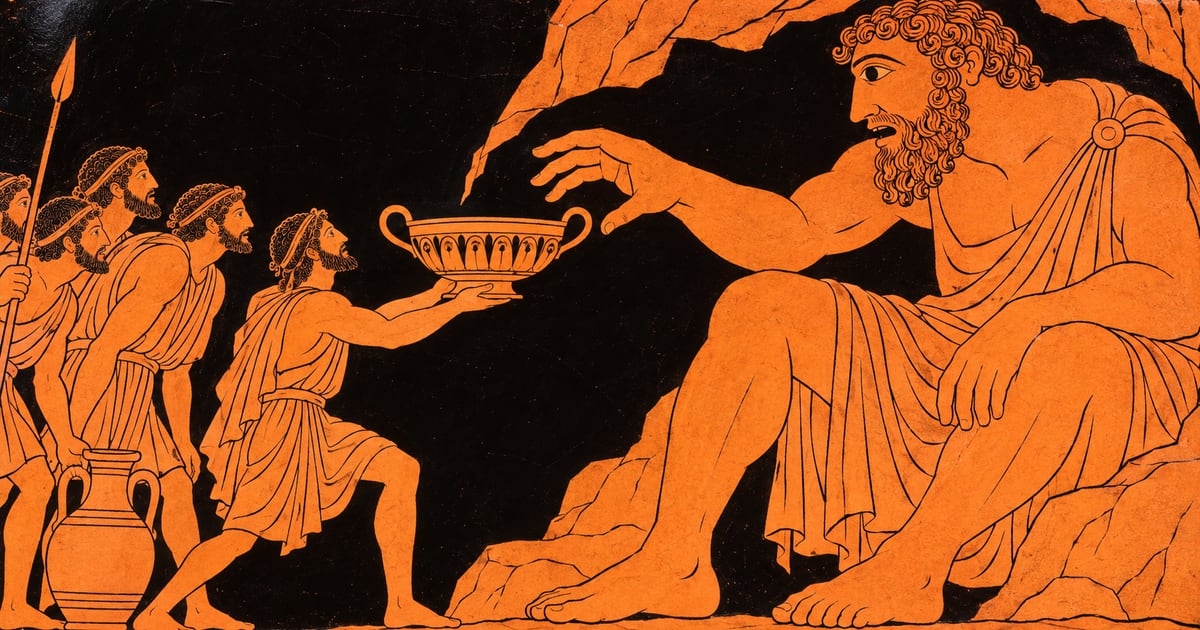
When Christopher Nolan's The Odyssey reached cinemas in July, viewers who knew the story waited for one line. Trapped in a giant's cave, Odysseus says his name is Nobody. Later, blinded and screaming, the Cyclops tells his neighbors that Nobody is hurting him, and they go back to bed.
The line never comes. Nolan's Cyclops barely speaks. Asked about it on The Daily Show, the director was candid: "It's a pun. Puns in translation are tough." And: "I tried. It was not possible to work it in."
He was right, in a more interesting way than he had time to explain. In Homer's Greek the trick works twice. English can carry the first joke. The second one has never survived translation.
A name made out of "not anyone"
The scene is in Book 9 of the Odyssey, part of the long story Odysseus tells about his own wanderings at the court of the Phaeacians. He and twelve picked companions are shut in the cave of Polyphemus, a one-eyed son of the sea god Poseidon, who has already eaten several of them. Odysseus gets him drunk on strong wine, and when the Cyclops asks his guest's name, he answers (9.366):
Οὖτις ἐμοί γ᾽ ὄνομα· Οὖτιν δέ με κικλήσκουσι
Oûtis emoí g' ónoma; Oûtin dé me kiklḗskousi
"Nobody is my name. Nobody is what they call me."
In ordinary Greek, oú tis is simply "not anyone," the negative ou plus tis, "someone." Odysseus welds the two into a name, and he even declines it like one. The Dickinson College commentary on the passage points out that the regular object form of the pronoun would be oú tina; Odysseus says Oûtin, dropping a syllable so that it sounds like a proper name.
The Cyclops accepts it and makes a grim joke of his own: Nobody, he promises, will be eaten last, after all his companions. That is his guest gift. Then the wine takes him, he falls asleep, and the men drive a heated olive stake into his eye.
The joke English can carry
Polyphemus roars. The other Cyclopes, who live in caves nearby, come running and call in from outside the entrance. Is someone driving off your flocks? Is someone killing you, by trickery or by force? He answers (9.408):
ὦ φίλοι, Οὖτίς με κτείνει δόλῳ οὐδὲ βίηφιν.
Ô phíloi, Oûtís me kteínei dólōi oudè bíēphin.
"Friends, Nobody is killing me, by trickery and not by force."
This is the half that travels. "Nobody is killing me" is a perfect sentence and a perfect alibi, and English translations have long played it straight, calling the hero Nobody or, in older versions, Noman. A. T. Murray's Loeb translation of 1919 has "Noman is my name."
The joke English cannot carry
Now listen to the neighbors' reply (9.410):
εἰ μὲν δὴ μή τίς σε βιάζεται οἶον ἐόντα
ei mèn dḕ mḗ tís se biázetai oîon eónta
"Well, if no one is doing you violence, alone as you are..."
Then they tell him that a sickness sent by Zeus cannot be escaped, advise him to pray to his father Poseidon, and walk away.
Polyphemus said oû tis. His neighbors say mḗ tis. That is not a slip. Greek has two words for "not." Ou denies a statement of fact: Nobody is killing me. Mē negates whatever is less than a fact, such as conditions, wishes, fears and commands, and a clause that begins with "if" calls for it. Their worried questions a moment earlier used it too. The grammar of their reply bends Odysseus's fake name into a new shape.
And mē tis has a famous double. μῆτις, mêtis, is the Greek word for cunning intelligence, the quality Odysseus is known for. One of his standing epithets in Homer is polýmētis, "of many wiles."
The poem makes sure we hear it. As the Cyclopes leave, Odysseus tells us (9.413-414):
ὣς ἄρ᾽ ἔφαν ἀπιόντες, ἐμὸν δ᾽ ἐγέλασσε φίλον κῆρ,
ὡς ὄνομ᾽ ἐξαπάτησεν ἐμὸν καὶ μῆτις ἀμύμων.
hṑs ár' éphan apióntes, emòn d' egélasse phílon kêr,
hōs ónom' exapátēsen emòn kaì mêtis amýmōn.
"So they spoke as they went away, and my heart laughed, that my name and my flawless mêtis had fooled them."
The neighbors meant "if no one." Odysseus heard "if cunning," and laughed. Nobody had beaten the giant, and so had mêtis, and in Greek those were almost the same sounds.
The language hinge
Here are the three pieces side by side:
| Greek | Transliteration | Literally | In the scene |
|---|---|---|---|
| Οὖτις | oûtis | "not anyone" | the false name Odysseus gives |
| μή τις | mḗ tis | "not anyone," in its "if" form | what the neighbors say |
| μῆτις | mêtis | "cunning intelligence" | what Odysseus says fooled them |
In the oldest copies, the difference between the last two did not show at all. Greek was written in capital letters with no spaces between words, and the accent marks that modern editions use to separate μή τις from μῆτις were added by later scholars, beginning in Hellenistic Alexandria. On such a page, ΜΗΤΙΣ is the same five letters either way. Spoken aloud, the two differed in the pitch on a single vowel.
That is the half Nolan had to give up, along with most translators. In English, "no one" stays "no one" after "if," and nothing in "no one" sounds like "cunning." A translation can tell you there is a pun. It cannot make it land. Murray, faithful as ever, writes "my name and cunning device," and the echo is gone.
The name he could not keep
Then Odysseus spoils it. Sailing away with the survivors, he cannot resist shouting back: if anyone asks who blinded you, say it was Odysseus, sacker of cities, son of Laertes, whose home is in Ithaca (9.502-505).
The nameless man escaped. The named man can be cursed. Polyphemus prays to Poseidon, naming him in exactly those words, that Odysseus never reach home, or if he must, that he arrive late and in misery, having lost all his companions, on someone else's ship, to find trouble in his house (9.528-535). That prayer reads like a summary of the rest of the poem.
Even the Cyclops reaches for the joke without knowing it. He had always expected, he says, some big, handsome hero, and instead a man "small and outidanós and feeble" put out his eye (9.515). Outidanós means worthless, a man of no account. It is built from the same two pieces: ou, "not," and an old form of ti, "anything."
What we do not know
We cannot ask Homer, or the generations of singers behind the poem, how hard they leaned on the pun. Commentators read line 414 as the punchline because the poem puts mêtis exactly where Odysseus laughs; the Dickinson commentary says that in this episode the nameless stranger is "pure intelligence." How easily an early listener heard mḗ tis as mêtis depends on a pitch accent we can reconstruct only in outline.
The name has an open edge too. Stories of a man who blinds a one-eyed giant and escapes his cave are told far beyond Greece, but the commentary notes that the name Outis is unique to the Odyssey's version.
And Nolan's choice was a fair one. A film can show a stake and a blinded eye. It cannot show a negative changing shape after "if."
Learning which "not" Greek wants is ordinary first-year grammar. It is also the moment a joke more than 2,500 years old starts working on you again. That is the kind of moment PRAVIEL's Classical Greek course is built toward.
Sources
- Homer, Odyssey 9, Greek text ed. A. T. Murray (1919), Perseus Digital Library
- Homer, Odyssey 9, trans. A. T. Murray (1919), Perseus Digital Library
- Thomas Van Nortwick and Rob Hardy, Homer: Odyssey 5-12, Dickinson College Commentaries (2024), on 9.360-408
- Devin Meenan, "How Christopher Nolan's The Odyssey Changes The Iconic Cyclops Showdown," /Film, July 18, 2026
- Wiktionary, "οὐτιδανός"
Ready to learn an ancient language?
Learn a few minutes a day, from the first letters to real texts, with every line spoken in the language's own tradition. Start free with Latin or Greek, or with Egyptian, Hebrew, and more.
Conversation
Comments
Leave a note, correction, or question. Comments are moderated and email addresses are not shown publicly.
Loading comments...