
Why Michelangelo's Moses Has Horns
Michelangelo carved Moses with two horns because the Latin Bible said his face was horned. The Hebrew word behind it can point to horns or to rays of light, and a translator's choice shaped five centuries of art.
In the church of San Pietro in Vincoli in Rome, Michelangelo's marble Moses sits with one hand in his long beard and two short horns rising from his head. Michelangelo carved him around 1513 to 1515 for the tomb of Pope Julius II. Visitors who know the story of Exodus often wonder where the horns came from, because the Bible they read says nothing about horns.
The answer is one Hebrew word. When Moses comes down from Mount Sinai carrying the tablets of the law, Exodus 34:29 says he did not know that the skin of his face qāran, because he had been speaking with God. Modern translations say it "shone" or "was radiant." Jerome's Latin Vulgate, the Bible of the Western church for a thousand years, says cornuta esset facies sua: his face "was horned."
Neither reading is a slip of the pen. The Hebrew can lean either way, and the horns are the record of a translator choosing.
A word with two meanings
The verb qāran is rare. It shares its root with qeren, the everyday Hebrew word for a horn: the horn of a ram or an ox, and the horn as an image of strength. In Psalm 69 a related form describes a young bull "with horns." Yet the same root can also describe light. In Habakkuk 3:4, God's brightness has qarnayim at his side, which modern translations render as "rays," though the verse is difficult.
So a reader of Exodus 34:29 has a real choice: did Moses' face put out horns, or rays? The oldest translation chose light, and more than light. The Greek Septuagint, made by Jewish translators centuries before Jerome, says that the appearance of the skin of his face "had been glorified." Jerome knew that Greek. He also knew the strictly literal Greek version of Aquila, a Jewish scholar of the second century CE, which called the face "horned." Jerome followed the literal option.
Horns before Michelangelo
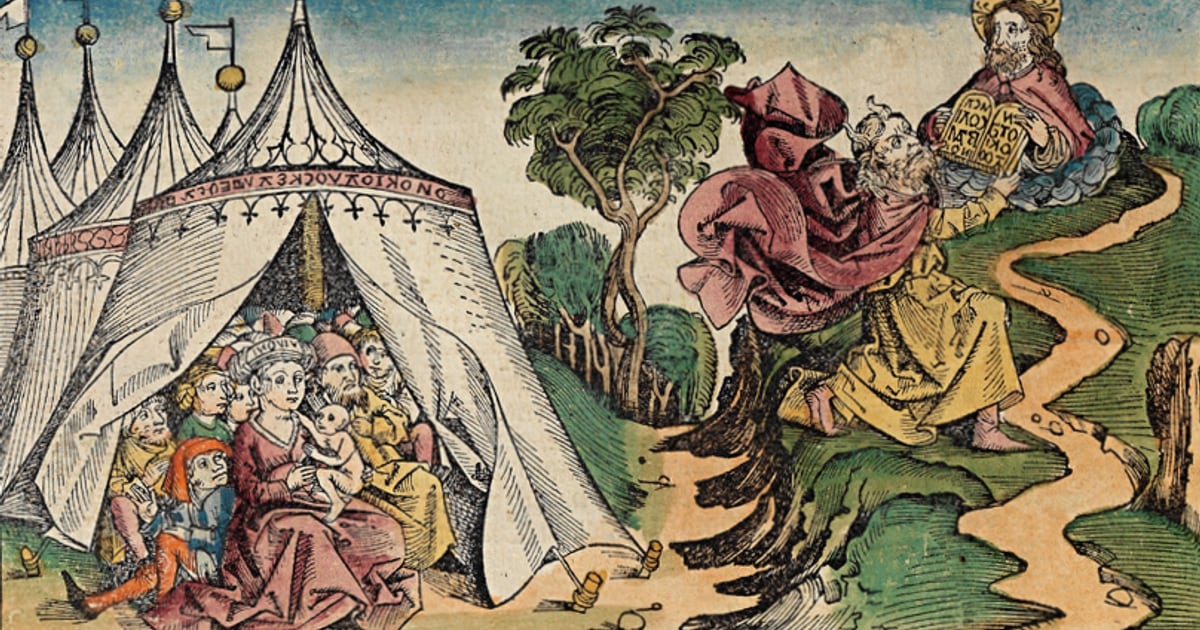
Jerome probably did not mean anything monstrous. Horns in the Hebrew Bible often stand for strength and honor, and medieval theologians read his cornuta as a way of saying "glorified." Artists read it literally. Horned Moses probably first appears in art in the eleventh century, in an illustrated Old English translation of the first books of the Bible made before about 1050, where the Old English text itself calls him gehyrned, "horned." For the next five centuries horned and hornless images of Moses competed.
Not all of it was innocent. In the later Middle Ages, horned images of Moses sat alongside an antisemitic slander that Jews had horns, and may have helped it spread. By about 1500, scholars knew the Latin was doubtful. Michelangelo's Moses comes near the end of the tradition, and it is generally read as a positive portrait of the prophet.
The language hinge
Three ancient translators faced the same verse and gave three answers.
| Version | What it says | Key word | Reading |
|---|---|---|---|
| Hebrew, Exodus 34:29 | qāran ʿôr pānāyw | qāran | "the skin of his face shone," or "sent out horns" |
| Greek Septuagint | dedoxastai hē opsis tou chrōmatos tou prosōpou autou | dedoxastai | "the appearance of the skin of his face had been glorified" |
| Latin Vulgate | cornuta esset facies sua | cornuta | "his face was horned" |
The Greek translators resolved the ambiguity toward meaning: whatever happened to Moses' face, it was glory. Jerome resolved it toward the word: qeren is a horn, so cornuta. Most modern translations choose light. The horns survive in marble.
What we do not know
We do not know exactly what the author of Exodus pictured: glowing skin, rays, or something deliberately strange. We do not know whether Jerome meant cornuta as a figure of speech his readers would decode, as many medieval readers assumed, or as a literal description. And we cannot always tell which horned images were reverent and which carried contempt.
What we can do is read the verse ourselves. Biblical Hebrew, Classical Latin and Koine Greek are all among PRAVIEL's courses, and Exodus 34:29 is a place where reading the three side by side shows a translation being made, one word at a time.
Sources
- Wikipedia, "Horns of Moses"
- Wikipedia, "Moses (Michelangelo)"
- Exodus 34:29, Hebrew text with the JPS translation, Sefaria
- Habakkuk 3:4, Hebrew text with the JPS translation, Sefaria
- Psalms 69:32, Hebrew text with the JPS translation, Sefaria
- Exodus, Latin Vulgate text, The Latin Library
- Exodus 34:29, Septuagint interlinear, StudyBible.info
Ready to learn an ancient language?
Learn a few minutes a day, from the first letters to real texts, with every line spoken in the language's own tradition. Start free with Latin or Greek, or with Egyptian, Hebrew, and more.
Conversation
Comments
Leave a note, correction, or question. Comments are moderated and email addresses are not shown publicly.
Loading comments...