
The Oldest Recipes Leave the Cooking to You
Babylonian tablets from about 1730 BCE hold the oldest known recipes. They name the dish, list what goes in and say almost nothing else. One Akkadian word and one Latin word show how much the cook was trusted to know.
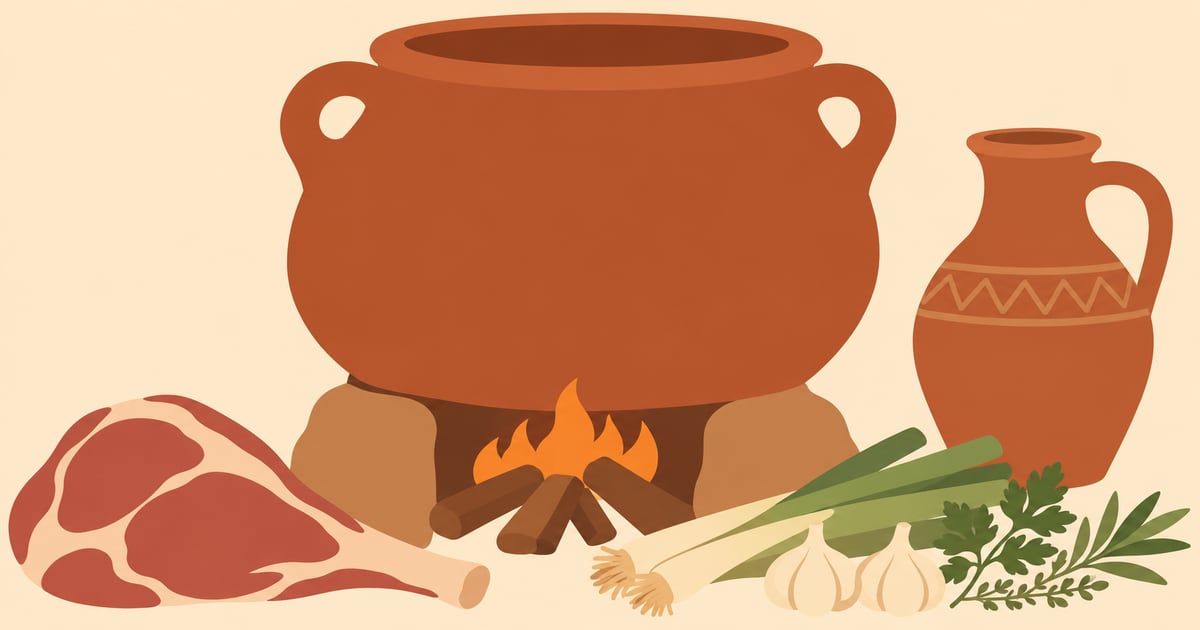
Here is a recipe nearly four thousand years old, in the translation of the team that cooked it:
Tuh'u. Leg meat is used. You prepare water. You add fat. You sear.
It goes on: salt, beer, onion, arugula, cilantro, Persian shallot, cumin and what is probably red beet; then crushed leek and garlic; coriander sprinkled on top; kurrat and fresh cilantro to finish. That is all of it. No quantities, no times, no heat, no word on how to tell when it is done.
It reads like a note for someone who already knew how to cook. That is the most interesting thing about the oldest recipes we have, and the reason a modern kitchen has to supply so much of them.
Four tablets at Yale
The recipes are written on clay tablets in the Yale Babylonian Collection. Three of the four are Old Babylonian, written no later than about 1730 BCE; the fourth is Neo-Babylonian and more than a thousand years younger. The best preserved, YBC 4644, lists twenty-five stews, twenty-one with meat and four without. The language is Akkadian, the Semitic language of Babylon, written in cuneiform. The team that published them most recently calls them the oldest known culinary recipes, and adds, honestly, that "the reason why the recipes were compiled is unknown."
The French Assyriologist Jean Bottéro first translated the tablets in the 1980s. In 2019 a team from Harvard, Yale and beyond, among them the Assyriologists Gojko Barjamovic and Agnete W. Lassen and the culinary historian Nawal Nasrallah, published fresh translations of four recipes and cooked them, many times, with students.
A pot, some fat and no numbers
The recipes share a rhythm. Each names the dish, says whether meat is used and then begins: "You prepare water. You add fat." The meatless pašrūtum takes kurrat, a leek-like plant, with cilantro, salt, leek and garlic, and ends with dried sourdough, pounded, sifted and scattered over the pot before it comes off the fire. Its name is conventionally translated "Unwinding." The cooks offer two guesses why: perhaps because it is a mild comfort dish, perhaps for what the sourdough does when it meets the liquid.
"Like most premodern cooking manuals," they write, "the Babylonian recipes rarely list the quantities of each ingredient." How much, how long and how hot they had to work out by cooking and tasting.
Rome's best-known cookbook works the same way, two thousand years later. The Latin collection called Apicius, in ten books, carries the name of a first-century gourmet, but the version we have was probably compiled in the fourth or fifth century, perhaps by several cooks, in a Latin closer to everyday speech than to Cicero's. It also gives lists and verbs and trusts the cook with the rest.
The language hinge
Two small words show how much a translation decides.
The first is Latin. Here is the start of a pear dish from Book 4 of Apicius:
Pira elixa et purgata e medio teres cum pipere, cumino, melle, passo, liquamine, oleo modico.
"Boiled pears, cleaned out from the middle, you will pound with pepper, cumin, honey, raisin wine, liquamen and a little oil."
Then eggs go in, the mixture is baked as a patina, a set dish, and pepper goes on top. The word that matters is liquamine, from liquamen. Joseph Dommers Vehling's 1936 English translation, the one most readers find online, renders it "broth." Today it is usually read as fish sauce: the liquid drained from small fish fermented in salt, so close to the famous Roman garum that by late antiquity the two names were used for the same thing. Follow Vehling and you make a sweet, spiced pear custard. Follow the Latin as it is now understood and you season that custard with fermented fish, sweet and savory at once, which is much stranger and much more Roman.
The second word is Akkadian. The Akkadian for beer is šikarum, usually written with a single cuneiform sign, 𒁉, read KAŠ. It is an old Semitic word, a cousin of Biblical Hebrew šēkār, which the King James Version renders "strong drink" ("Do not drink wine nor strong drink," Leviticus 10:9). In Babylon it meant beer brewed from grain. A modern cook reading "beer," though, reaches for a modern bottle. Students working with the team brewed their own from barley and let it ferment for a few days. The result was "a light drink with some acidity and only trace amounts of alcohol." The closest modern substitute, the cooks suggest, may be a mix of sour beer and German wheat beer. And: "Bitter India Pale Ales will not work."
Both translations are fair. "Beer" is the right word for šikarum, and "broth" was a defensible guess for liquamen in 1936. What neither English word can carry is the kitchen around it.
What we do not know
A good deal. Some ingredients are uncertain; the published translation itself puts a question mark beside the beet. Nobody knows who wrote the Yale recipes down, or for whom. The cooks say plainly that "cooking the recipes, even to the best of our ability, may not reproduce the almost four-thousand-year-old dishes in a form close to the intended one." They see the stews as an early stage of a tradition still at the heart of Iraqi cooking; that is a plausible line of descent, though nearly four thousand years is a long way to trace it step by step. And dishes worth writing on clay, or copying into a Roman manuscript, are not what most people ate on most days.
What the tablets do show is how much one written word could lean on knowledge that was never written down. Classical Latin is one of PRAVIEL's courses, and reading liquamine in the original is the moment the pear custard changes flavor.
Sources
- Gojko Barjamovic, Patricia Jurado Gonzalez, Chelsea A. Graham, Agnete W. Lassen, Nawal Nasrallah and Pia M. Sörensen, "The Ancient Mesopotamian Tablet as Cookbook," Lapham's Quarterly, June 11, 2019
- Wikipedia, "Yale culinary tablets"
- Apicius, De re coquinaria, Book 4, Latin text, The Latin Library
- Apicius, Cookery and Dining in Imperial Rome, trans. Joseph Dommers Vehling (1936), Project Gutenberg
- Wikipedia, "Apicius"
- Wikipedia, "Garum"
- Wiktionary, "šikarum"
Ready to learn an ancient language?
Learn a few minutes a day, from the first letters to real texts, with every line spoken in the language's own tradition. Start free with Latin or Greek, or with Egyptian, Hebrew, and more.
Conversation
Comments
Leave a note, correction, or question. Comments are moderated and email addresses are not shown publicly.
Loading comments...